


If you feel like SEO is harder than it used to be, you are not imagining it. But the reason probably is not what you think.
Most people assume the problem is competition. More websites, more content, more businesses fighting for the same top spots. That is part of it, sure. But it is not the real story.
The real story is that search itself has broken into pieces. Your customers no longer start every journey in a single Google search box. They start in a dozen different places, depending on what they are looking for and how they feel that day. I call this the fragmentation of discovery, and once you understand it, a lot of your frustration starts to make sense. More importantly, once you see the whole map, you can stop feeling behind and start making smart choices about where to put your energy.
What “discovery” used to look like
For roughly two decades, the path was simple. Someone had a need, they typed it into Google, they scanned the first page of results, and they clicked. If you ranked well, you got found. If you did not, you were invisible.
That single doorway is exactly what made SEO feel manageable. There was one game, one scoreboard, and one set of rules to learn. You could obsess over a handful of keywords, climb the rankings, and reliably watch the traffic follow.
Here is what changed: the doorway multiplied. And each new doorway came with its own rules, its own gatekeepers, and its own version of “winning.” Let me walk you through where discovery actually happens now, and give you something practical to do about each one.
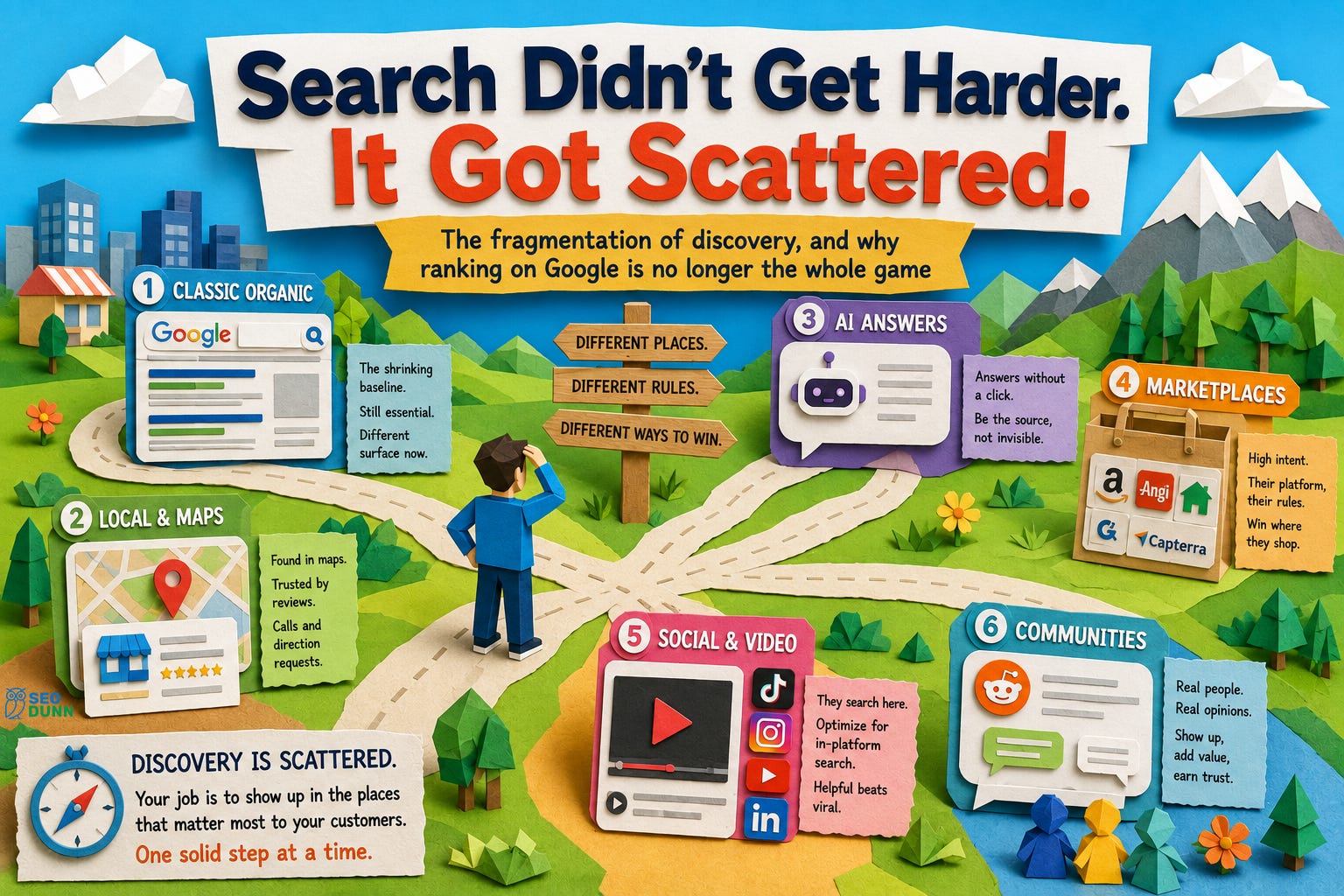
Fragment 1: Classic organic (the shrinking baseline)
Let us start with the channel you already know, because even it has changed under your feet.
Traditional organic results, the plain blue links, are still the largest single source of traffic for most businesses. But “ranking number one” does not mean what it used to. The top of a Google results page is now crowded with AI Overviews, a local pack, video carousels, “People Also Ask” boxes, and ads. Your number one organic result might not appear until a reader has scrolled past all of that.
So classic organic is still essential, but it is no longer the whole page, let alone the whole game. It is the foundation the other fragments build on, which is exactly why you protect it first and never abandon it chasing shiny objects. If you want the full picture of how Google decides who earns those classic rankings, I broke it down in Google Is Interviewing Your Website Right Now, which walks through the KNOW, LIKE, and TRUST signals behind it.
What to do about it:
Keep your site technically sound and genuinely useful. A fast, well-structured, trustworthy site still wins here, and it feeds every other channel below.
Target the questions, not just the keywords. The page real estate above your listing rewards content that answers real questions clearly.
Do not measure success by rankings alone. A number one ranking that sits below an AI answer and a map pack is worth less than it used to be. Track the traffic and leads, not just the position.
Fragment 2: Local and Maps
For a huge number of businesses, this is where the real money lives, and it is a completely separate discovery surface from classic organic.
When someone searches “plumber near me,” “best dentist,” or “coffee open now,” Google often answers with a map and three local listings, called the local pack, before a single traditional result appears. Many of those searches never leave Google Maps at all. The customer finds a business, reads the reviews, taps the phone number, and books. No website visit required.
The rules here are their own world. Google ranks local results on three things in plain English: proximity (how close you are to the searcher), relevance (how well your business fits the search), and prominence (how well-known and trusted you are, driven heavily by reviews). Your Google Business Profile, not your website, is the star of this show.
This is also where my KNOW, LIKE, and TRUST framework shows up most visibly. Your Business Profile is where Google confirms it KNOWS who you are, LIKES what customers say about you, and TRUSTS you enough to put you on the map, literally.
What to do about it:
Claim and fully complete your Google Business Profile. Every field, correct categories, real photos, accurate hours. Half-finished profiles lose to complete ones.
Keep your name, address, and phone number (NAP) identical everywhere. On your site, your profile, and every directory. Inconsistency quietly erodes trust with both Google and customers.
Make reviews a system, not an afterthought. Ask every happy customer, respond to every review (good and bad), and never, ever buy fake ones. Reviews are the single biggest lever on local prominence. (They are also a target for bad actors, so it is worth knowing how to protect them, which I covered in The Growing Threat of Fake Review Extortion.)
Post and update regularly. A profile that is actively maintained signals a real, open business. A stale one signals the opposite.
For the deeper local playbook, including NAP consistency across Maps, Apple Maps, Bing Places, and Yelp, plus local landing pages and ongoing review management, see AI Search + SEO In 2026: The Ultimate Small Business Playbook.
Fragment 3: AI answers inside search
Start with the AI that shows up while people are still using a search engine. When someone searches on Google today, they often see an AI Overview at the very top, a written answer stitched together from multiple sources, before any traditional result. Bing does the same with Copilot. The person still “searched” the normal way, but a machine now answers first.
This is a quieter shift than it looks, because it changes the value of your hard-won ranking. For years the goal was a click. Now, in a growing number of searches, there is no click at all. And this is not a small trend. One study found that Google searches ended without a click 68% of the time in the U.S. during early 2026, up from about 60% in 2024 (Search Engine Land). Pew Research also found that when an AI summary appears, people are far less likely to click any link at all (Pew Research Center).
So you can rank number one and still watch the AI answer above you satisfy the question before anyone scrolls to your listing. The new goal is to be one of the sources that AI Overview pulls from and names.
What to do about it:
Answer real questions directly and early. These AI answers favor content that states a clear answer up front, then explains it. Lead with the answer, then support it. (This also happens to be good writing.)
Use clean structure. Headings that ask the question, short paragraphs, and simple lists make it easy for an AI to lift your content as a citation. A wall of text is much harder to quote.
Strengthen the classic-organic signals underneath. AI Overviews draw heavily from pages that already rank well, so a strong classic-organic foundation directly feeds your odds of being cited here.
Fragment 4: AI search and chat
This is the genuinely new front door, and it is different enough to stand on its own. Here people skip the search engine entirely. They open ChatGPT, Perplexity, or Claude and just ask. There is no results page, no ten blue links, no map pack. There is one conversation, and often one answer.
That difference matters. In classic search you compete for a position on a page. In AI chat you compete to be inside the answer itself, or among the handful of sources the tool decides to cite. If the model does not know who you are, or does not trust you enough to mention you, you simply do not exist in that conversation. There is no “page two” to fall back to.
Here is why this matters for your bottom line. If someone asks ChatGPT “what should I look for when hiring an SEO company,” and the answer quietly recommends the qualities your competitor happens to be known for, you just lost a customer you never even knew was shopping. You were not outranked. You were left out of the answer entirely.
What to do about it:
Be consistent about who you are. These tools cross-check your business name, location, and areas of expertise across the web. If your details conflict from site to site, you look less trustworthy, and trust is the currency here.
Earn third-party mentions. AI chat leans heavily on what other credible sources say about you, not just what you say about yourself. A mention in an industry article or a strong body of reviews carries more weight than another page on your own site.
Build genuine, documented expertise. These tools reward sources that clearly demonstrate real experience and authority, which is exactly the kind of signal that is hard to fake.
If you want the specific tactics for both this and the AI answers above, I laid them out in AI Can Handle Your SEO Basics. Here’s What It Can’t Do., which covers entity optimization, earning citations in the sources AI trusts, and reverse-engineering how AI tools answer questions in your industry.
Fragment 5: Marketplaces
A huge share of buying-intent searches never touch Google at all. People searching for a product often start directly on Amazon. People looking for a contractor might start on Angi or Houzz. People comparing software start on G2 or Capterra. People booking travel start on Booking.com or TripAdvisor.
These marketplaces have become search engines in their own right, each with their own ranking rules, their own reviews, and their own optimization game. (And yes, “Amazon SEO” is a real and separate discipline, with its own algorithm.)
Here is the part that surprises people: the buyer on a marketplace is usually much closer to purchase than the buyer on Google. Someone typing your product into Amazon is not researching, they are shopping. So if that is where your category lives, ignoring it means skipping the customers with their wallets already open.
What to do about it:
Find out if your category even has a dominant marketplace. Sell physical products? Amazon almost certainly matters. Run a home-services business? Check whether Angi, Thumbtack, or Houzz drives your competitors’ leads.
Treat your marketplace listing like a landing page. Optimize the title, the images, the bullet points, and above all the reviews. Reviews are the ranking fuel on nearly every marketplace.
Do not cede your own brand name. If people can buy your product on a marketplace, make sure your listing there is excellent, or a reseller will build a worse one for you.
Fragment 6: Social and video
Younger buyers in particular now treat social platforms as search engines. They look for restaurants on TikTok, products on Instagram, professional expertise on LinkedIn, and how-to answers on YouTube. Google’s own research found that almost 40% of young people, when looking for a place for lunch, go to TikTok or Instagram instead of Google Maps or Search (TechCrunch).
And do not overlook YouTube, which is effectively the world’s second-largest search engine. When people want something demonstrated, from a recipe to a repair to a software walkthrough, they search YouTube directly.
This is not casual scrolling. It is intentional searching, just on platforms that Google does not control and that your website does not live on. Someone types “best tacos near me” into TikTok’s search bar and watches three short videos before deciding where to eat. That is a search, start to finish, with no website involved.
What to do about it:
Match the platform to your audience, not the trend. LinkedIn for B2B expertise. YouTube for anything people want demonstrated. TikTok and Instagram for visual, local, or lifestyle products. Do not spread yourself across all of them.
Optimize for in-platform search, not just the feed. Put the words people actually search into your captions, spoken audio, and on-screen text. These platforms read all three.
Think “helpful,” not “viral.” A video that clearly answers a common customer question will keep getting found in search long after the trend-chasing content is forgotten. Evergreen beats viral for discovery.
Fragment 7: Niche communities
Then there are the trusted corners of the internet: Reddit threads, Discord servers, Facebook groups, industry forums, and Slack communities. When someone wants an honest recommendation rather than a marketing message, this is where they go.
Interestingly, Google noticed this too. That is partly why you now see so many Reddit results on the first page. Reddit’s visibility in Google search jumped more than 1,300% between mid-2023 and early 2024 (eMarketer), and “best [product] reddit” has become one of the most common search patterns online. People trust real humans in real communities, and the search engines are following that trust.
This one comes with a warning, because it is the easiest to get wrong. Communities can smell marketing from a mile away, and they punish it hard. You cannot barge in and promote yourself.
What to do about it (carefully):
Show up as a human, not a billboard. Answer questions helpfully in the communities where your customers already gather. Reputation compounds slowly here, but it is durable.
Monitor mentions of your brand and your competitors. These threads are honest, unfiltered market research. What people praise and complain about is gold.
Never fake it. Astroturfing (planting fake recommendations) is the fastest way to get banned and publicly shamed. It also violates everything I believe about doing this work honestly. It is not worth it.
And it does not stop there
Those seven are the fragments that matter most for the average business, but the splintering runs even deeper, and it will keep going. Voice assistants like Siri and Alexa often read back a single spoken answer, which raises the stakes on being the one source that gets cited. Visual search, through Google Lens and Pinterest, lets people point a camera and search without typing a word. And feeds like Google Discover surface your content to people who were not even searching yet.
You do not need to chase all of these. You just need to know they exist, so the map stops surprising you.
Why this makes SEO feel so much harder
Put all of this together and the picture becomes clear. Ranking well in traditional Google results now covers a smaller slice of where discovery actually happens.
So even if your rankings are steady, your visibility can feel like it is shrinking. Here is what that means in plain English: you can be winning the old game and still losing ground, because the game moved to fields you were not playing on.
That is a genuinely different challenge, and it explains the exhaustion a lot of business owners describe. It is not that you are doing worse. It is that the same amount of effort now covers less territory. Imagine you spent years becoming the best shop on one street, and then the town quietly built six more shopping districts. You did not get worse. The map got bigger.
A simple diagnostic: map your own fragmentation
Before you change anything, spend an afternoon figuring out where your discovery actually happens. Here is an exercise I walk clients through.
List your top five customer questions or needs. The real ones people come to you with.
Search each one in several places: Google, Google Maps, an AI tool (ChatGPT or Perplexity), YouTube, the top marketplace for your category, and Reddit or a relevant community.
Write down who shows up. Is it you? A competitor? A map listing? A random Reddit thread? An AI summary that names no one?
Score each channel as Strong, Weak, or Absent for your business.
Look for the gap that matters most. You are hunting for the channel where your customers clearly are and you clearly are not.
That gap is your priority. Not every channel at once. The one where the distance between “customers are here” and “we are here” is widest.
What to actually do about it
The honest answer is that no one wins on every front at once, and you should be suspicious of anyone who promises you will. This takes time, and SEO Dunn right is patient by design. But here is a grounded way to approach it.
Protect your Google foundation first. Classic organic and local are still the largest channels for most businesses, and they feed the AI answers layered on top. A strong, credible website and a fully optimized Business Profile are the base everything else builds on.
Become citable, not just rankable. AI answers pull from sources they trust, which means clear content, documented expertise, consistent business information, and third-party validation. Rankable gets you a link. Citable gets you named in the answer. The second one is where discovery is heading, and it is exactly what I dig into in The Superpower Paradox, where AI levels the tools and real expertise becomes the differentiator.
Pick one additional channel and do it well. Use your diagnostic above. Choose the single platform beyond your foundation where your customers clearly gather, and commit to it for six months. One channel done consistently beats five done halfway, every time.
Track the right things. Rankings alone no longer tell the whole story. Watch brand searches, direct traffic, calls and direction requests from your Business Profile, “how did you hear about us” answers, and whether AI tools mention you when asked about your category.
Stay honest through all of it. Every channel above has a shortcut that promises fast results, and every one of those shortcuts eventually blows up. Fake reviews, astroturfed community posts, keyword-stuffed listings. None of it lasts, and all of it puts your business at risk. There are no shortcuts worth your reputation.
The takeaway
SEO is not dying, and it did not suddenly get harder because you fell behind. Discovery simply scattered across more places than any single search once covered.
The businesses that will do well from here are not the ones chasing every shiny platform. They are the ones who understand where their customers actually look, build genuine trust in those specific places, and stay patient enough to let it compound.
Search broke into pieces. Your job now is to show up in the pieces that matter most to your customers, and to do it honestly, one solid step at a time. That is what doing SEO Dunn right looks like in a fragmented world.