


More and more, I’m seeing fundamental changes in the role of an SEO and what we need to provide to our clients… and it isn’t getting any easier for them or us. More specifically, I’m going to focus on SEO consulting (including regular hands-on optimization), since that’s more in keeping with my familiarity and role assisting small and medium-sized businesses.
» Note: this article was originally posted on my company site here.
As AI incorporates itself into every facet of business, it’s overwhelming to everyone, especially busy business owners trying to make the best decisions for their companies.
Sure, AI gives us more tools to simplify and even eliminate certain tasks we don’t like or find time-consuming. But that just raises the bar for what we all need to do to stay ahead of the competition.
After all, this advantage isn’t unique to us.
The competition has these same tools and advantages, and we have to assume they’ll also utilize them as effectively as possible.
So where does that leave SEOs? What do we need to do to evolve in the AI era?
I’m growing increasingly certain that a significant part of an SEO consultant’s role will become guidance for the effective implementation of AI to support client efforts. That will likely include suggesting the best AI models, prompts, and aiding in the choice of soon-to-be ubiquitous SaaS SEO DIY platforms, providing third-party oversight to ensure AI processes are delivering smart recommendations (heaven knows that’s required), or combining that oversight with careful implementation of AI suggestions by an expert hand (the ideal solution for clients).
Many of these additions to the SEO role are already underway.
I’m seeing more businesses conducting their own SEO and competitive research at varying levels of competency. Sometimes our clients share their research findings with us, and the ideas aren’t half bad. We encourage everyone to use AI to inform themselves and learn more about their online marketing. If it doesn’t immediately help them, it at least helps them understand and appreciate what SEOs do.
Thankfully, I have yet to speak with any of our clients who have applied recommendations without first reviewing them with us. However, there’s no doubt that many businesses are implementing AI-generated SEO advice independently to cut outside expenses, and will continue to do so. Unfortunately, there’s always a chance that recommendations beyond the most basic could backfire and reduce search engine visibility instead of improving it. Heck, even Google’s documentation emphasizes the importance of human expertise and oversight in content creation and optimization.
Before long, I expect there will be enough horror stories of poor AI SEO DIY implementations that SEOs will be called upon to be a guiding light, at the very least.
So How Should an SEO Prepare for These Changes?
AI Immersion
If you haven’t already been spending untold hours testing and iterating with AI to build it into your SEO processes, you need to get on it yesterday.
There are so many aspects of AI that you need to experience to understand, appreciate, or simply recognize its limitations. Many times, I’ve spent countless hours testing, trying to utilize AI in ways it’s simply not capable of, and leaving my computer in a fit of frustration.
The thing is, I’m always convinced I can find a way to get it right, but I never really know if I can. Sometimes I don’t succeed, and I have to move on to another approach.
That’s the additionally frustrating part of AI: it’s a rabbit hole!
There always seem to be other ways of accomplishing what you’re trying to do, yet sometimes those ideas bear no fruit, and you find yourself another 20 to 100 hours behind your main objective.
At any rate, in my opinion, learning AI and recommending solutions to clients will take hands-on experience. You don’t want to be left behind without any insight into how to bend it to your will successfully.
If you’re wondering where to start with AI, I suggest buying a pro account with ChatGPT or Claude (my favorite) and trying to create actionable insights you can evaluate. The Search Engine Journal’s AI guide provides excellent starting points for SEO-specific applications.
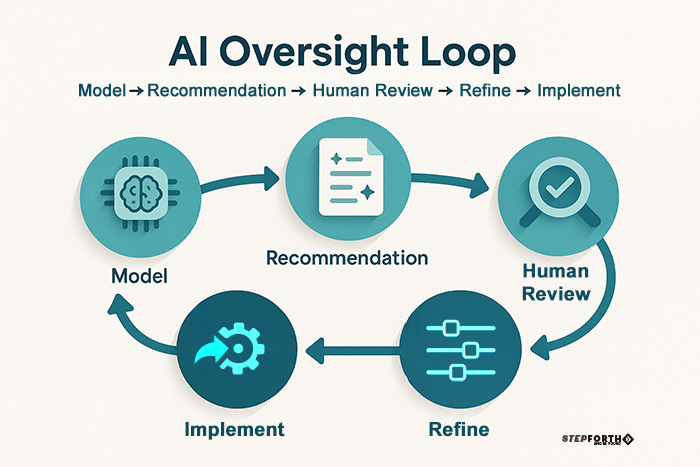
Just ensure you never take what AI provides as gospel! Always verify the data it provides and review it thoroughly before acting upon it.
A diagram of the importance of reviewing an AI output and then refining before implementing it to any content.
Deepening Client Relationships
SEOs should also become even more familiar with their clients’ businesses so they can be more proactive and insightful with marketing advice.
Thankfully, it’s now easier than ever to do so at scale.
Ask AI to analyze their company and their competitors. Grab their buyer personas and dig into them. See if you can expand upon them, or use AI with an API from Semrush or Moz to enhance them for SEO purposes.
AI has given SEOs a mind-blowing, endlessly malleable toolset we can use to explore our clients’ worlds. Use these new insights to your advantage and become an irreplaceable part of your clients’ future plans.
Keep Your Nose Clean
SEOs should also realize that we’re approaching a time when your reputation as a provider of quality SEO services will mean more than ever—and I don’t just mean learning how to leverage your authority in SERPs (that’s next).
Anyone interested in hiring you or your company can now simply ask AI to research your business. Within minutes, an interested party can view a sentiment analysis of your results from publicly available information, discover your average pricing, verify whether your business claims are true, and more.
I’m quite hopeful this new method of reviewing vendors will cut bad vendors off from any income. With time, maybe the SEO industry will be whittled down to the most reliable providers and only a small percentage of the bad actors that give us all a bad name.
Truly Own Your Expertise and Authority
It’s time for those of us who prefer to avoid the limelight to embrace it. We need to make it undeniable to the online world that we are experts in our field. This means connecting our credentials (video or podcast appearances, articles, press, education, etc.) to a single, canonical persona that AI and search engines can vet to determine our expertise, authority, and ultimately, trustworthiness. This aligns with Google’s E-E-A-T guidelines, which increasingly value demonstrable expertise.
I finally tackled this a couple of years ago, but only took it seriously these past few months by tying as many profiles and content pieces as possible to a single URL, RossDunn.com. This way, I have maximum control over my personal identity, and it’s business agnostic; important since I have a couple of companies, and I expect not all references I point here will be business related. My site is far from complete, but I feel great finally having built some momentum on this task.
I suggest all SEOs, from fellow entrepreneurs to employees, create their own personally controlled URL and begin this process immediately. This will remove your reliance on your bio at your current employer and give you the extra control you need to build out and own your online authority, no matter where you work. This also applies to any professional who wants to control their persona online.
As I mentioned, this will pay dividends when you change jobs, but it will also allow you to apply your hard-earned authority to content you create anywhere online.
A diagram showing the important connection between a person’s canonical bio site and their author page on any site
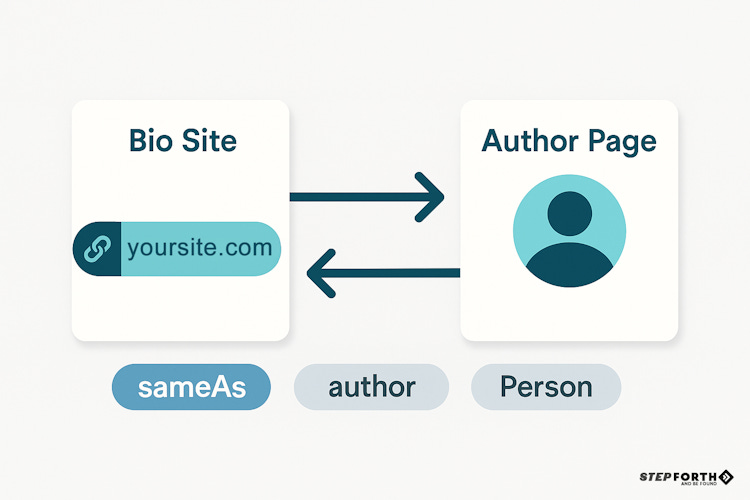
For example, if you decide to write for a third-party site and want to ensure your author profile there benefits from your authority, you only need to link to your bio site from your author page (using sameAs schema) and back to the author page from your bio site (“I am an author at [site name with URL to your bio]”). This closed loop demonstrates authenticity and will allow your pre-built authority to transfer to the new author page and corresponding content, while also passing any authority you gain from your writing back to your bio site.
Educating Clients
Lastly, I believe it’s our role, more than ever, to educate clients regularly on what they should and should not pay attention to online.
They’re being inundated with noise! Falsehoods, half-truths, and some genuinely great ideas abound. Sadly, there’s little doubt this is only going to get worse—much worse—as everyone and their dog tries to capture business by leveraging this AI boom of information and misinformation.
Be their rock.
Consider creating a client-only newsletter. Its purpose would be to clarify and guide them by sharing news you find insightful while clearly identifying what should be ignored. The Google Search Central Blog and Search Engine Land are excellent sources for verified updates worth sharing.
Adapt or Get Left Behind
I’m sure I’m missing numerous ways our jobs as SEOs are going to change, and I may update this article when more come to mind. That being said, I think this is plenty enough to get us started on the right path. The key is to begin adapting now, before the wave of change leaves us behind.