


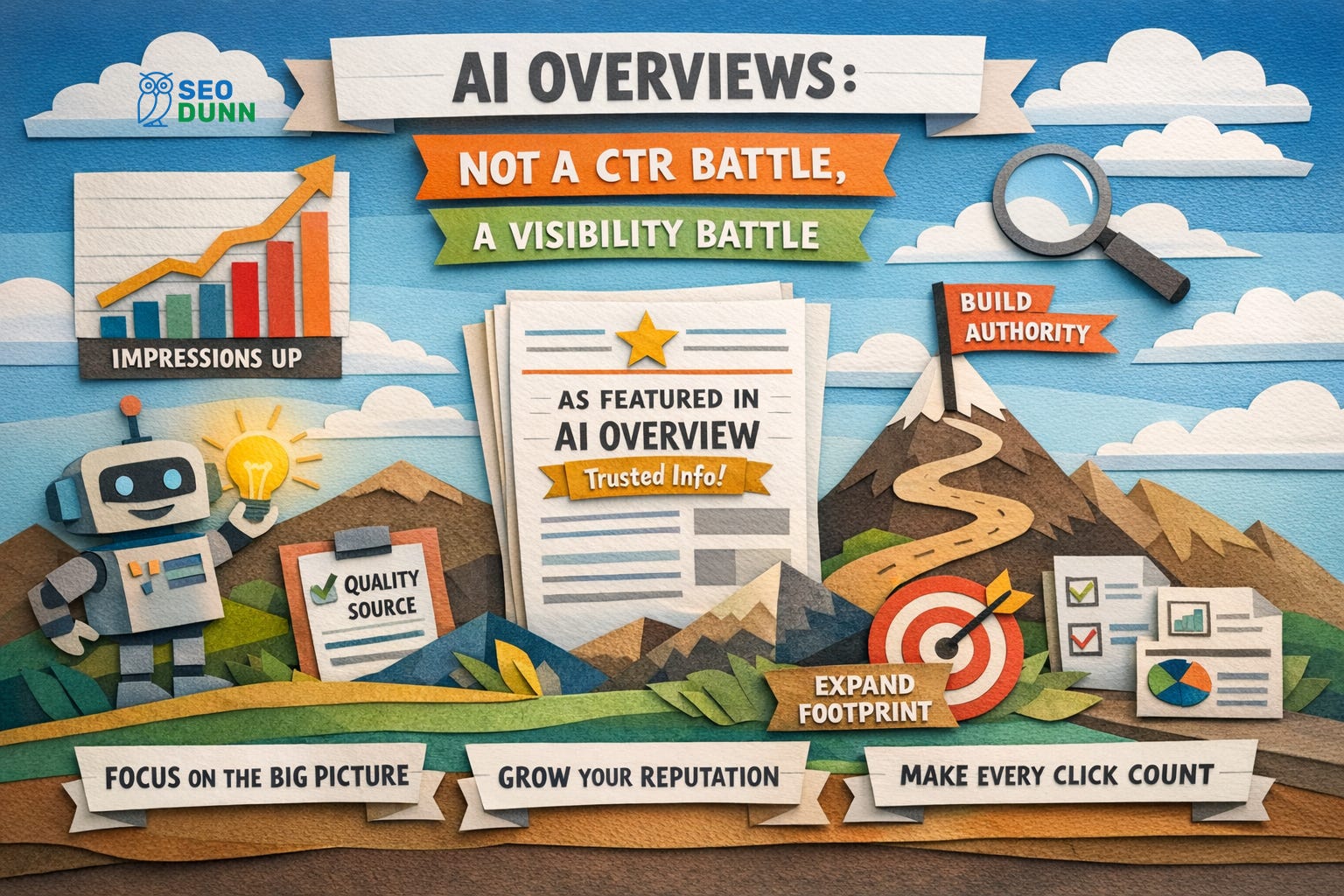
If your site has started appearing in Google’s AI Overviews, you have probably seen a pattern like this in Google Search Console:
Impressions are climbing
Clicks are flat or dropping
Click-through rate (CTR) looks worse than it used to
On the surface, this feels wrong. You have finally been pulled into the shiny AI box at the top of the search results, visibility jumps, and yet users read the AI answer and move on without visiting your site.
So you start wondering:
How do I increase clicks along with impressions?
Should I optimize titles and descriptions specifically for AI Overviews?
Should I structure content to “hold back” part of the answer so users have to click for the full story?
Here is the uncomfortable truth: some of those clicks are gone. Users really are getting more from the search results page itself.
But that is not the whole story.
We can acknowledge the loss of some clicks and still recognize that being cited in AI Overviews is a major positive signal for your site. You do not win this game by trying to claw back every last click. You win by treating every AI citation as a vote of confidence and using that momentum to grow your overall footprint.
Let’s unpack how to think about this.
1. What AI Overviews Are Actually Telling You
When your content is selected as a source in an AI Overview, Google is effectively saying:
“Of all the content we could have used to construct this answer, your page was one of the best options.”
That matters.
To reach that point, your page usually has to:
Be technically accessible and easy for Google to crawl and parse
Be tightly aligned with the query’s intent
Provide a clear, well structured answer
Sit on a site that appears credible and relevant for that topic
In other words, AI selection is a quality and authority signal, even if it does not immediately show up as more clicks for that specific query.
SEO has always had a lag between work and payoff. Think of AI citations as:
Early evidence you are moving in the right direction, and
A reputational asset that influences how search engines see you across many related queries, not just one AI result.
Is it frustrating that some users do not click? Of course. But this is the new search reality. Complaining about it will not change the interface.
Our job is to adapt strategically.
2. Why Chasing AI CTR Is A Dead End
Two reactions are very common when people see impressions up and clicks down:
“Maybe I should rewrite my titles and meta descriptions specifically for AI Overviews.”
“Maybe I should only give part of the answer so people are forced to click.”
Both are understandable. Neither is where you should spend your energy.
2.1 “Optimizing” titles and meta descriptions for AI Overviews
You should absolutely keep writing strong titles and meta descriptions:
Clear and specific
Matched to search intent
Written for humans first
Those still matter for classic organic results.
However, AI Overviews do not behave like traditional snippets where Google might directly reuse your meta description. The AI is generating its own wording, then linking out to sources.
That means:
It may paraphrase your content
It may ignore your title structure
It may use anchor text that is completely different from your carefully crafted meta
Trying to control the exact language AI uses to describe your link is like trying to control how every blogger summarizes your article when they cite you. You can influence them with clarity, but you cannot script them.
So:
Keep writing excellent titles and descriptions for users and standard search results
Make sure they honestly reflect the content of the page
Just do not expect AI to respect your preferred phrasing. That way lies a lot of effort for very little impact.
2.2 Holding back the answer to “force” clicks
Another instinct is to structure content so the page gives only a partial answer, with the idea that:
“If I do not give everything away, users will have to click through for the full picture.”
This might sound clever, but it is usually counterproductive.
If you deliberately withhold the core answer, you:
Give users a worse experience when they do visit your page
Make your content less useful as an AI source
Risk being passed over in favor of a competitor who answers fully and clearly
Both users and Google are looking for complete, trustworthy answers. When content feels thin or evasive, it is less likely to be picked up as a source and less likely to earn long term trust.
If the AI Overview can answer the core query using your content, that is actually a positive sign. It means you have created something dense and useful enough to power a summary.
Instead of holding back, focus on:
Thorough, well structured answers to the primary question
Deeper layers of context, examples, and implementation details that go beyond what a quick AI summary can fully capture
Clear “next steps” for users who do click and want more than the basics
Let the AI handle the quick overview. Your job is to own the deeper journey.
3. What To Focus On Instead: Exposure And Footprint
The real strategic question is not:
“How do I get every AI impression to result in a click?”
It is:
“How do I turn AI citations into long term authority and more total business, even if some individual CTR metrics go down?”
That requires a shift in focus.
Instead of fixating on the click rate from one AI result, concentrate on:
Being cited in AI Overviews for more queries in your topic area
Being recognized as a reliable source across an entire cluster of related topics
Turning that perceived authority into traffic, leads, and revenue across your whole footprint
Here is how to do that in practice.
3.1 Study what got you cited and replicate it
If you are already being used as a source in AI Overviews, something about that page is working.
Audit that page:
How is the content structured?
Are there clear headings that map to specific questions?
Is the language concise and direct?
What questions does it answer particularly well?
How comprehensive is it compared to your other pages?
Then, use those strengths as a model for adjacent content:
Build out pages on closely related questions
Cover supporting topics, common problems, comparisons, and “what next?” queries
Create a cluster of content around the topic rather than a single heroic article
The goal is to become the obvious source for an entire topic ecosystem, not just one query. That is how authority compounds over time in both AI Overviews and traditional organic search.
3.2 Make your pages obviously “worth the click”
Even when the AI Overview does a solid job answering the initial query, some users will still click if they believe there is more value on the other side.
Increase the perceived value of a click by:
Adding elements AI cannot fully replicate, such as:
Detailed comparison tables
Step by step checklists
Calculators, tools, or downloadable resources
Real world case studies or examples
Using subheadings that promise depth beyond the basics, for example:
“Real world examples from the field”
“Step by step implementation guide”
“Common mistakes and how to avoid them”
Think of the AI Overview as the appetizer. Your page should clearly signal that it is the main course.
3.3 Expand the number of ways people can “meet” your brand
If you consistently publish solid, well structured content around a topic, several things tend to happen over time:
You get cited in more AI Overviews for related queries
You rank for more long tail and supporting searches in traditional results
Users who do click start to recognize your brand, name, or site as a recurring authority
You are not playing for one click on one query.
You are playing for:
More branded searches involving your name or company
More direct visits from people who now trust your expertise
Better performance across dozens or hundreds of thematically related queries
AI is, in a sense, advertising your expertise at the top of the page. Even when it does not deliver an immediate click, it is still planting seeds.
4. How To Measure This Without Going Crazy
If you only look at CTR for a handful of AI‑influenced queries, you will almost certainly feel like you are losing.
Instead, adjust what you measure:
Total impressions for the topic cluster
Look at all relevant queries for that topic, not just one keyword
Evaluate trends over 3, 6, and 12 months
Total clicks from the topic cluster
Some specific queries will have worse CTR due to AI
Others may gain as your authority grows and you rank for more variations
Branded search and branded CTR
Monitor searches that include your brand or domain name
If those are trending upward, AI and organic visibility are doing their job
Leads and revenue tied to that topic
Are you getting more qualified inquiries in that area?
Are closed deals or signups increasing even if some CTR numbers look worse?
The key question becomes:
“Is my growing presence in AI and organic search driving more overall business and authority, even if certain traditional metrics are noisier?”
If the answer is yes, then a declining CTR on one AI influenced query is not a disaster. It is simply a side effect of a changing interface.
5. The One Thing Not To Obsess Over
It is tempting to fixate on:
Micromanaging titles and descriptions in the hope that AI will use your preferred phrasing
Continually tweaking wording to “entice” more clicks from the AI box
Attempting to engineer partial answers so users are forced to visit your site
These tactics are fragile. They rely on implementation details of today’s interface that can change tomorrow.
What is far more durable is:
Demonstrable expertise
Clear, comprehensive, well structured content
A growing body of work that covers your topic area thoroughly
A brand that users start to recognize and seek out directly
That approach survives interface changes, algorithm updates, and new AI features far better than any short‑term trick.
6. Bringing It All Together
If your impressions are rising from AI Overviews while clicks and CTR are falling, here is a practical way to respond:
Accept the tradeoff.
Some clicks will stay on the results page. Fighting that reality is wasted energy.Recognize the upside.
Being cited in AI Overviews is a strong vote of confidence in your content and your site’s authority.Replicate what worked.
Use the pages that are already being cited as models for additional content around the same topic cluster.Make every visit count.
Add depth, examples, tools, and implementation details that AI cannot fully replace.Measure the bigger picture.
Focus on topic‑level impressions, total clicks, branded search, and business outcomes, not just CTR on a single AI influenced query.
If you keep producing the kind of content that AI wants to cite and that humans want to dig deeper into, your authority will grow.
AI is not just “stealing” clicks. It is also repeatedly signaling to search engines and users:
“This site is a reliable source on this topic.”
Your job is to keep giving it more reasons to say that, across more of the queries that matter to your business.
the shift from CTR to "citation breadth" is the right frame but man does it create a measurement headache.
with traditional SEO you had clear signals -- rankings, clicks, conversions. now you need to track how many queries you're being cited for across an entire topic cluster, and whether that's expanding or contracting over time.
the branded search lift is probably the clearest indicator that visibility work is paying off. if people start searching for "[topic] + your brand" more often, the AI exposure is working even without direct clicks.
Bottom of funnel really helps me as well