


Search has split into two.
On one side, you still have universal Google search results: perhaps an AI Overview, ads (and more ads), map packs, Google Business Profiles, and some blue links interspersed with more hard-to-detect ads.
On the other, you now have AI-only results: Google’s AI Mode, ChatGPT, Claude, Perplexity, and a growing crowd of “answer engines” that skip the ten blue links and tell your customers what they should do, who they should hire, and where they should go.
In 2026, your small business has to pass two interviews at once:
The old interview with Google’s ranking systems.
The new interview with AI systems that read the whole web, summarize it, and choose which businesses to name (hopefully, your business will be included)
The good news: the things that help you win in one almost always help in the other. The bad news: “good enough” content and neglected profiles are being quietly buried.
This article is your operating manual for both.
Small Business Playbook for AI & SEO
1. The New Reality: People Search In Two Ways Now
Here is what has changed in plain language:
Many people still type “dentist near me” into Google and click a local result.
A growing number type or say:
“I am terrified of dentists. Who is good with anxious patients in Victoria, and what should I ask during the first visit?”
Then they read a single AI answer that references 2 or 3 dentists and gives very specific advice.
Behind the scenes, both Google and AI tools are:
Reading your website
Scanning your Google Business Profile
Analyzing your reviews and mentions
Comparing you to your competitors
Deciding whether you are safe to recommend
In other words, your online presence is being “interviewed” constantly.
I have written before about how Google interviews your website. In my example, I suggest that Google needs to know KNOW, LIKE, and TRUST your business. That same framework is now quietly influencing whether AI tools ever speak your business name out loud.
To win in 2026, you need to understand both interviews and deliberately prepare for them.
2. How Google Thinks: KNOW, LIKE, TRUST
Let us start with Google’s side of the table.
Google’s ranking systems are essentially asking three questions about your business:
KNOW: Are you real and legitimate?
LIKE: Do people get value from what you offer?
TRUST: Why should we believe you and recommend you?
If you fall down in any one of these, your rankings suffer. In 2026, AI systems are reading the same signals and quietly using them again.
2.1 KNOW: Can We Verify You Exist?
This is Google’s basic due diligence check.
They look for:
Consistent NAP
Your Name, Address, and Phone number (NAP) should be consistent on:Your website
Your Google Business Profile
Major directories (Apple Maps, Bing, Yelp, industry-specific sites)
If your name, address, and phone are a mess, Google and AI systems hesitate. They do not like recommending mysteries.
Basic technical health
HTTPS (padlock in the browser)
A site that loads reasonably fast on mobile
No accidental “do not index me”(noindex) instructions in robots.txt or meta tags
Navigation that a spider and a human can both understand
Think of KNOW as: “Can I even be sure you are who you say you are, and that you want to be found?”
2.2 LIKE: Do People Enjoy The Experience?
Once Google is reasonably sure you exist, it moves on to value.
Key LIKE signals:
Helpful, plain language content
Pages that actually answer real questions your customers ask, not just a pile of keywords.Reasonable page speed and user experience
No “click here and wait 15 seconds while the site chokes on 19 tracking scripts”
No full-screen pop-ups covering the main content
Text that humans can read on a phone without zooming and pinching
Clear explanation of your services
If a visitor cannot figure out the following within 10 to 15 seconds, your LIKE score will suffer.:What you do
Who you do it for
Where you operate
Visuals that show reality
Real photos, videos, and examples give visitors confidence and keep them on the page. Google notices.
2.3 TRUST: Why Should We Recommend You?
This is where many small businesses underinvest, and it now affects both Google and AI results.
Trust signals include:
Reviews and ratings (on Google, and often elsewhere)
Detailed testimonials (on your site, with names and stories)
Backlinks and mentions from relevant, trustworthy sites
Evidence of expertise:
Years in business
Certifications and training
Media features, speaking, guest posts
Detailed case studies with real outcomes
For AI systems like ChatGPT and Claude, these are the clues that separate a genuine expert from a template site spun up last week.
3. How AI Search Works (In terms a business owner actually cares about)
Think of your AI of choice as a super-smart librarian who reads all the books before recommending which ones to show you. Instead of just matching keywords like the old card catalogue system, AI now understands what you’re really asking and synthesizes information from multiple sources. This means your website needs to be written for this intelligent assistant, not just for keyword matching.
Here is a more nuanced breakdown that’s still for human consumption:
When someone asks an AI:
“Who is the best physiotherapist in Kelowna for runners with knee pain, and what questions should I ask before booking?”
Under the hood, the AI does what is called query fan-out.
Instead of asking one giant question, it silently explodes that prompt into many small ones, such as:
Which physiotherapists are actually in Kelowna?
Which of them mentions helping runners or sports injuries?
Who has pages or articles about knee pain?
Which ones have good reviews mentioning “runner”, “knee”, “sports injury”, or similar phrases?
Which sites look trustworthy, current, and not spammy?
Then, very quickly, it:
Hits multiple sources: Google results, websites, directories, sometimes PDFs and other data sources.
Reads and compares everything.
Synthesizes a single, confident-sounding answer.
Chooses 1 to 3 businesses to name, if any.
This happens in milliseconds, but the logic is familiar: the AI is basically doing what a careful human researcher would do, only at machine speed.
Now pair that with the “superpower paradox”:
Everyone, including your competitors, can now use AI to pump out content.
So content volume is no longer a differentiator.
Real-world experience, proof, and clear structure are the differentiators.
AI tools love sources that:
Clearly explain topics in structured sections
Contain specific, real-world details
Look and feel like they were written by someone who has actually done the work, not just read about it
If your business relies on Google and local discovery, ignoring this is not just risky. It is an invisible, slow leak in your pipeline.
4. The 2026 Checklist: 30+ Things Small Businesses Should Actually Do
Here is a long, practical list.
Think of this as your 12-month roadmap.
You do not need to do everything in week one.
You do need to decide which 5 or 6 moves are highest impact for you right now.
I grouped them by theme.
A) Make Your Business “Legible” To Google And AI
1. (Local Businesses) Fix Your NAP Everywhere
If your Name, Address, and Phone number are not consistent, fix that pronto.
Ensure the exact same name, address, phone, and primary URL appear on:
Your website
Google Business Profile
Apple Maps, Bing Places, Yelp, and any major industry directory
Avoid cute variations. “Rob’s Plumbing & Heating Ltd.” and “Rob’s Plumbing and Heating” seem like small differences, but if it happens enough, it can look untrustworthy.
2. Repair Technical Landmines
If Google cannot crawl or index you, everything else is irrelevant.
At minimum:
Check you are using HTTPS and your SSL certificate is valid.
Ensure key pages are not blocked in robots.txt and do not have a meta noindex.
Make sure your main navigation uses normal links, not fancy JavaScript that hides everything from search engines.
Run a basic speed check using Google PageSpeed Insights and fix catastrophic issues (20 second loads, huge uncompressed images).
3. Clarify Your Services And Locations
Avoid one vague “Services” page that lists twenty things in a paragraph.
Instead:
Create one focused page per core service.
If location matters, create dedicated pages like:
“Teeth whitening in Victoria”
“Emergency plumbing in Nanaimo”
Each page should spell out:
What this service is
Who it is for
Where you offer it
How to get started
4. Improve Your Titles and Meta Descriptions
Your page titles and meta descriptions are still the front door of your search presence.
Title format that works:
“Family Dentist in Victoria, BC | XYZ Family Dental”
Meta description example:
“XYZ Family Dental helps anxious patients and busy families in Victoria with gentle checkups, cosmetic dentistry, and same-day emergency appointments. Call for new patient availability.”
If your titles are all “Home” and “Services”, you are leaving rankings and clicks on the table.
B) Turn Your Content Into The “Best Answer” In Your Niche
5. Build A Few “Big Answer” Pages
For each of your most valuable services, create one page that tries to be the best explanation in your region.
Include:
A short, plain English summary at the top
What the service is and who it is for
How it works, step by step
Pricing, or at least realistic price ranges
Pros, cons, and alternatives (even if that alternative is “go to a competitor”)
A FAQ section answering common questions and objections
Real examples or case stories, with outcomes
AI systems and Google both gravitate to comprehensive, structured pages like this.
6. Write In Question & Answer Form
You want your content to line up directly with the questions real people ask.
Use headings exactly like:
“What is [service]?”
“How much does [service] cost in [city]?”
“How long does [service] take?”
“Is [service] worth it?”
“What are the risks of [service]?”
This is not “SEO trickery”. It is simple: most users and AI tools are literally asking those questions.
7. Document Real-World Experience
Do not just say “we are experienced”. Prove it.
Create case studies with:
The situation: who the client was (at least type, if not name) and what they struggled with
What you did: the process, decisions, and tradeoffs
The outcome: numbers where possible, or at least tangible improvements
Lessons: what you learned and what you would do differently next time
These are gold for both:
Visitors who want evidence you can do what you claim
AI systems looking for specific, non-generic details
8. Upgrade Your About Page Into An “Expertise Page”
Most About pages say almost nothing useful to search engines or customers.
Instead, include:
Years in business and why you started
Relevant training, certifications, and memberships
Notable wins: awards, big projects, media features
Your philosophy and how it is different from common industry mistakes
A photo and a real, human story
This strengthens your E E A T signals, which both Google and AI engines care about.
C) Treat Reviews and Local Reputation as a Ranking Factor Twice
9. Aim For Steady, Ongoing Reviews
Google and AI tools prefer businesses with a healthy, recent review profile.
Practical approach:
Ask every happy client within 24 to 48 hours of the work, using email or SMS.
Make it easy with a direct Google review link.
Ask 1 or 2 specific questions to guide better reviews:
“What problem did we solve for you?”
“What would you tell a friend who is unsure about hiring us?”
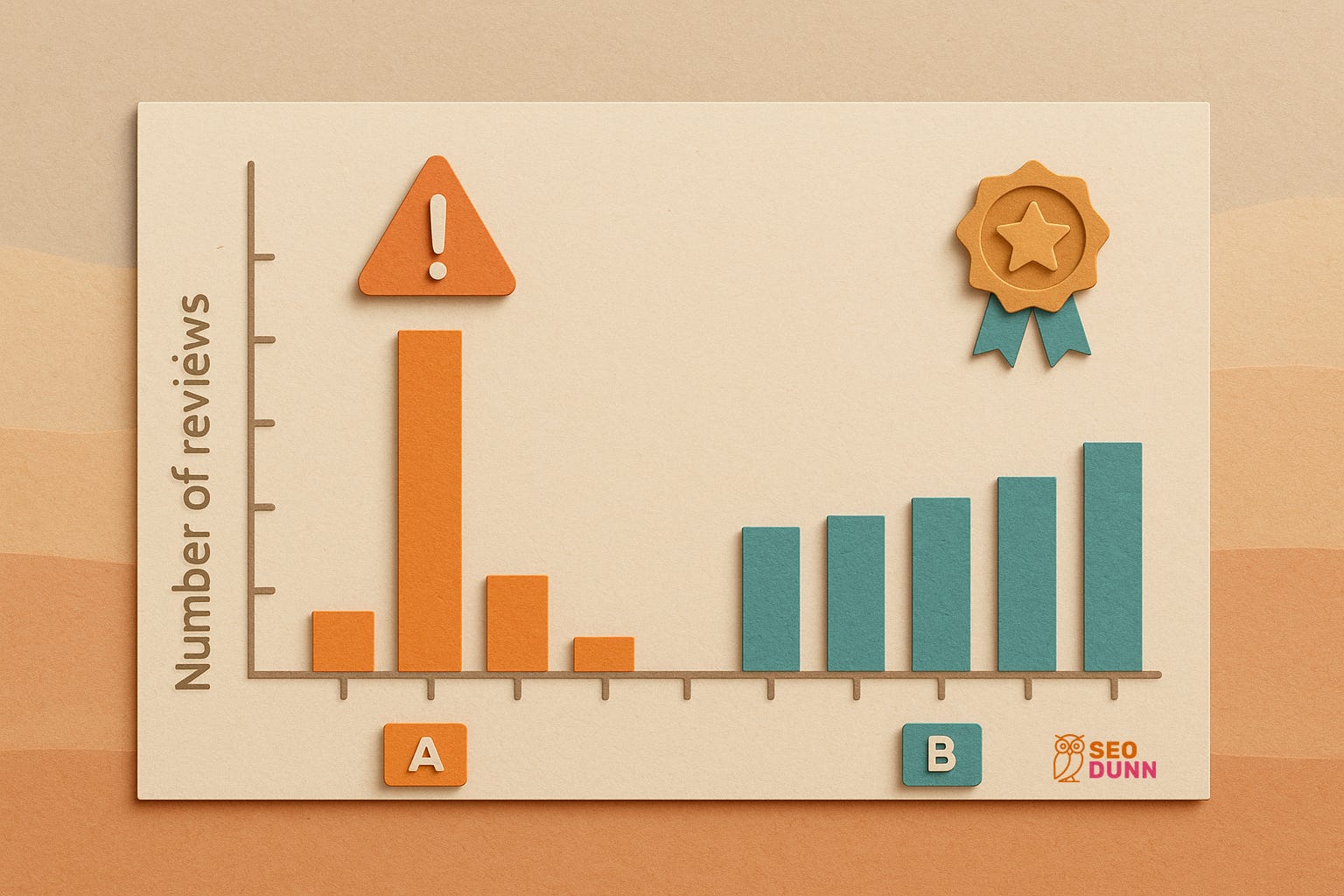
A slow, steady stream of genuine reviews beats a one-time burst of 30 reviews from 2019.
10. Respond to Reviews as if Future Customers are Reading Them
Because they are.
For positive reviews:
Thank them by name.
Mention a specific detail of the service they received (if allowed).
For negative reviews:
Stay calm and professional.
Acknowledge the issue.
Explain, briefly, what you did or will do.
Offer a direct line to resolve.
You are not just replying to that one person. You are sending a signal to everyone else, including AI systems, about how you handle problems.
11. Have a Playbook for Fake Reviews and Extortion
Sadly, fake review extortion has grown into a real problem. The playbook is:
Document everything: screenshots, emails, messages.
Flag each fake review in your Google Business Profile.
Report to national fraud or cybercrime agencies where applicable.
Never, ever pay.
Your article can link to the proper forms and agencies by country. This alone can be a life saver for some readers.
D) Make Your Content Easy for AI to Quote
You want to make it very simple for AI systems to lift accurate, well-structured chunks (of content) from your site.
12. Use Clean, Logical Headings
Basic structure:
One H1 per page for the main topic
H2s for major sections
H3s for sub sections
Bullet lists for steps, pros and cons, and key points
Do not overcomplicate this. You are helping machines map topics to answers.
13. Add Short Definitions and Key Point Summaries
At the top of important pages, include:
A 2 to 3-sentence definition or summary
A short “Key points” list
For example:
“Teeth whitening is a cosmetic dental treatment that lightens the colour of your teeth. In our Victoria clinic, we use a professional strength, dentist-supervised process that removes deep stains more safely than store-bought kits.”
Key points:
Safe, dentist-supervised treatment
Results in 1 to 2 visits for most patients
Suitable for coffee, tea, and wine stains
These pieces often get reused in snippets and AI answers.
14. Prefer Authoritative Guides Over Throwaway Posts
You are better off publishing one strong, 2,000 to 3,000-word guide than ten 300-word posts that all vaguely say the same thing.
In 2026, “blogging often” without depth is mostly noise. Google and AI systems have enough shallow content. They are actively hunting for genuine expertise.
15. Show That Your Content Is Current
You do not need to update every page weekly, but:
Add “Last updated” dates on important guides.
Review them at least once, preferably twice, per year.
Update anything that has clearly changed: prices, processes, laws, technology.
It signals that you are still actively practicing and paying attention.
16. Answer Niche, Specific Questions Your Competitors Ignore
This is one of the easiest ways to stand out.
Examples:
“Do you work with patients who use wheelchairs?”
“Is there parking on site?”
“What should I bring to my first appointment?”
“Do you work with this specific insurance provider?”
“Can I bring my dog if I am traveling from out of town?”
You would be amazed at how much goodwill (and how many conversions) these “small” details generate.
E) Use Multimedia to Make Your Content Stick
AI has made it dramatically easier to add charts, videos, and infographics. Google loves this. People love this. And yes, AI systems also use it as a quality hint. See the article I wrote on how to add AI-generated multimedia to your content for tutorials.
17. Turn Numbers Into Simple Charts
Whenever you talk about:
Timelines
Cost breakdowns
Before and after metrics
Comparison between options
Turn that into a chart or simple diagram.
18. Add Short Explainer Videos To Key Pages
You do not need a studio production.
A 60 to 180 second video that:
States the problem
Explains your approach in 3 steps
Tells them how to get started
And is enough to:
Increase time on page
Build trust quickly
Give AI tools a transcript full of useful phrasing
19. Create Visual Checklists and Process Diagrams
Infographics and simple process visuals are perfect to:
Clarify “what happens when I hire you”
Reassure nervous customers who hate surprises
Give other sites and social accounts something to embed and link to
You have already written a full guide on using AI to generate multimedia from existing content. Link to it for detailed prompts and tool recommendations.
F) AI Has Raised The Bar
This is the awkward part, but small businesses need to hear it plainly.
20. Accept That “Average” Content Is Now Worth Very Little
If your content looks like it could have been pumped out by a generic AI prompt in five minutes, do not expect it to drive significant business in 2026.
AI has flooded the web with:
“Top 10 tips”
“Beginner’s guides” that never get concrete
Content that sounds right but says nothing specific
Search engines and AI tools are learning to ignore that kind of fluff. So are your customers.
21. Invest In Documenting Real Proof
Your unfair advantage is not that you can type into ChatGPT.
Your unfair advantage is that you:
Have actually done the job
Have real clients, real results, real failures, and real lessons
Collect:
Before and after photos
Screenshots of dashboards and metrics
Quotes from clients
Project timelines and budgets (even rough ranges)
Mistakes you used to make and how you fixed them
These are exactly the kinds of details that AI systems cannot safely invent, and that Google values most.
22. Use AI As An Assistant, Not a Replacement For Strategy
In my experience, the pattern is always the same with new technology:
Tools get cheaper and louder.
Strategy gets more valuable, not less.
In 2026, your job (or your SEO’s job) is to:
Decide which topics matter
Decide which proof to show
Prioritize what to fix first
Maintain brand voice and accuracy
Then, yes, use AI tools to:
Draft versions faster
Turn text into video outlines and infographics
Summarize and reorganize raw material
But do not hand it the keys to your positioning or your ethics.
5. Helpful AI Prompts
Customize the following AI prompts to suit your needs.
Important: These prompts do not replace real strategy, but they dramatically lower the effort required to obtain decent first drafts that you or an SEO can refine.
Note: Over the next few weeks, I will be adding links to custom generators for each.
5.1 Prompt: Create a Strong Case Study for Your Business
You are an expert SEO and copywriter for small local businesses.

I will describe a real client job we completed.

Please:
1. Ask me 5 to 7 specific questions to capture the story (situation, what we did, results, quotes).
2. Then write a case study formatted for my website with these sections:
   - Client
   - Problem
   - Our approach
   - Results (with numbers if I gave you any)
   - What this means for similar customers

Use plain language that my non-technical customers will understand.
Do NOT invent any details I did not provide.

Do not use em-dashes
Do not hallucinate

Ask your questions now.5.2 Prompt: Upgrade a Boring Service Page Into a “Big Answer” Page
You are an experienced copywriter and SEO helping a small local business rank in Google and appear in AI search answers.

Here is the current content of my service page:
[PASTE YOUR EXISTING TEXT]

Please:
1. Identify the top 10 questions a skeptical customer would have about this service.
2. Rewrite the page to:
   - Clearly explain what this service is and who it is for
   - Answer each of the 10 questions in plain language
   - Include a short definition at the top (2 to 3 sentences)
   - Add a “Key points” bullet list
   - Add a short FAQ section with 4 to 6 common questions

Format the result with headings (H2, H3), bullet lists, and short paragraphs.
Do not change my prices or make up guarantees.
Do not use em-dashes
Do not hallucinate
5.3 Prompt: Turn One Article Into Charts, Video, and an Infographic
Note: your mileage may vary wildly on this one. If you want a more measured approach to doing this, check out my article on this very topic.
You are a content strategist helping me turn one blog post into multiple visual assets.

Here is my article:
[PASTE ARTICLE]

Create:
1. A list of 3 charts or diagrams I could add, with:
   - A title for each
   - The data or points each chart should show
2. A simple script outline for a 90-second explainer video that:
   - States the problem
   - Explains my solution in 3 steps
   - Ends with a clear call to action to contact my business
3. A text-only outline for an infographic with 5 to 7 sections.

Return your answer in clear bullet points that I can give directly to a designer or AI design tool.

Do not use em-dashes
Do not hallucinate
5.4 Prompt: Build a Simple 3 Month SEO + AI Content Roadmap
You are an SEO strategist from StepForth Web Marketing specializing in helping small local businesses in 2026.

My business:
[WHAT YOU DO, WHERE YOU ARE, IDEAL CUSTOMERS]

My top 3 most profitable services:
[LIST]

My current online situation:
[BRIEFLY DESCRIBE]

Create a 3-month content roadmap that:
1. Lists 8 to 12 high-priority content pieces (service pages, guides, FAQs, videos).
2. Labels each piece as:
   - SEO core (for ranking in Google)
   - AI visibility (for being cited in AI answers)
   - Trust building (reviews, case studies, proof)
3. Explains, in 1 or 2 sentences each, why this piece matters and how it helps me show up in Google and AI.

Keep this realistic for a busy small business with limited time.

Do not use em-dashes
Do not hallucinate
I repeat: These prompts do not replace real strategy, but they dramatically lower the effort required to obtain decent first drafts that you or an SEO can refine.
TIP! For even better results, make sure you include a copy of your writing style for the AI to work from. This way, whatever is written will be more likely to match your regular style.
6. The Part Nobody Likes: Google’s Volatility and AI’s Hunger
You can be doing many things right and still see:
Sudden traffic drops after an algorithm update
AI Overviews or other AI answers giving information without sending a click
Competitors who seem to “cheat” the system temporarily with spam tactics
I have written at length about how far Google has drifted from its “do not be evil” era and how often small businesses are collateral damage in its experiments.
The practical takeaway is:
You cannot control Google’s decisions.
You cannot fully control how AI tools choose to use your content.
You can control:
The strength of your brand in your market
The quality and clarity of your online footprint
The depth of your customer relationships
Your ability to adapt faster than your competitors
So your 2026 mindset should be:
Use Google and AI as powerful channels, not as benevolent overlords.
Invest heavily in durable assets:
Email lists
Remarketing audiences
Clear positioning
Documented expertise
Word of mouth powered by a strong review profile
An SEO to, at the very least, guide you (see below)
7. Why You Still Need a Human SEO In An AI World
If you are a small business owner, here is the blunt truth:
You should absolutely use AI tools. They are incredible leverage.
You should absolutely not expect them to think strategically for you.
The gap between “we used ChatGPT to write a blog post” and “we consistently show up in Google and AI answers for our most profitable services” is still large.
Bridging that gap requires:
Understanding how Google and AI actually evaluate your business
Prioritizing in the right order (fix technical issues before chasing AI visibility badges)
Translating real-world experience into content and proof that systems can understand
Avoiding the many quiet pitfalls that can nuke visibility overnight
That is where my work now lives: at the intersection of classic SEO, AI literacy, and real business constraints.
Together, we can:
Pick the 3 to 5 most important actions for your situation
Use AI to do the heavy lifting without losing your voice or accuracy
Build an asset base that survives the next wave of algorithm and AI changes, instead of relying on fragile tricks
If this article has surfaced three or four uncomfortable “we really should fix that” moments in your mind, that is a good sign. It means you are seeing the same landscape I see every day.
You do not need to tackle all 30 items at once. You do need a plan, a sequence, and someone in your corner who has already seen the horrors that haunt me when businesses ignore this stuff for too long.
If you’d like help, my team and I are here to support you.
Feel free to book a zero-pressure, free strategy call with me here.