


You’ve spent years creating content. Blog posts, service pages, FAQs, case studies. It’s good stuff. It ranks. It converts. It does the job you built it to do.
But here’s the uncomfortable truth: AI doesn’t care about any of that. Not the way Google’s traditional algorithm did.
AI search systems (Google’s AI Overviews, ChatGPT, Perplexity, Gemini, and others) are reading your website right now, breaking it into tiny chunks, and deciding whether your content is worth citing in their answers. Most of the time? It isn’t. Not because your content is bad, but because it was built for a different era.
The good news: you don’t need to start from scratch. You need to reform what you already have. And I’m going to show you exactly how.
The Shift You Need to Understand First
I wrote recently about how AI search results are created using a process called “query fan-out.” Instead of matching your page to a single keyword, AI breaks a user’s question into dozens of sub-queries, searches multiple sources simultaneously, and synthesizes one comprehensive answer.
Think about what that means for your content. In the old world, you needed a page that ranked for a keyword. In the new world, you need content that provides clear, extractable answers to the specific sub-questions AI is asking behind the scenes.
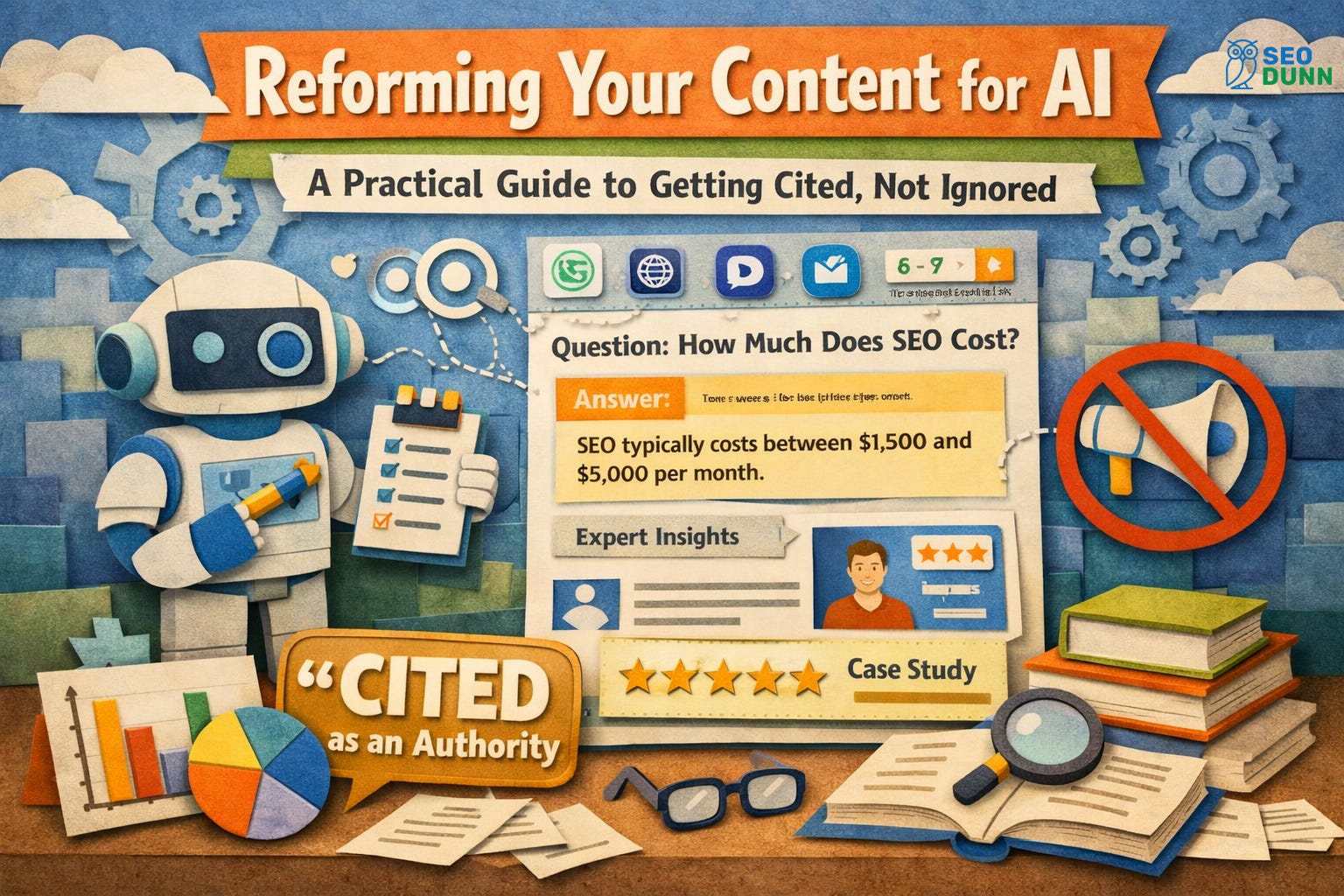
Here’s the critical distinction: AI isn’t ranking your pages. It’s citing them. And the difference between getting ranked and getting cited is the difference between showing up on a list and being quoted as an authority.
Why Your Current Content Probably Isn’t Getting Cited
Let me walk you through the most common problems I see when auditing client sites. You’ll probably recognize a few of these.
1. Your content answers broadly instead of specifically.
If your page title is “Everything You Need to Know About Kitchen Renovations,” AI has a problem. It doesn’t need everything. It needs the answer to “What’s the average cost of replacing kitchen countertops in 2026?” or “How long does a kitchen renovation typically take?” Your everything-page tries to cover it all but answers nothing precisely enough for AI to extract and cite.
2. Your expertise is buried.
You’ve got 20 years of experience, real client stories, and hard-won insights. But they’re hidden in paragraph seven of a 2,000-word blog post. AI systems are looking for content where expertise is front and center, not buried under filler. As I discussed in The Superpower Paradox, human expertise and real-world examples are becoming your greatest differentiators in a world flooded with AI-generated sameness.
3. Your structure was built for scanners, not extractors.
You formatted your content for human readers who scan (good!), but AI needs something more specific. It needs clear hierarchical structure where each section stands on its own as a citable answer. Your H2 says “Our Services,” but AI needs it to say “What Does a Full-Service SEO Audit Include?” See the difference?
4. You’re still writing to hit word counts instead of answering questions.
Thin “SEO content” written to target long-tail keywords but offering no real substance? AI filters that out fast. These systems evaluate semantic similarity and vector distance (fancy terms for “how closely does this actually answer the question?”), and padding doesn’t fool them.
“the difference between getting ranked and getting cited is the difference between showing up on a list and being quoted as an authority.”
The Reform Playbook: Seven Steps to AI-Citable Content
Alright, let’s get practical. Here’s the process I use with clients, and it works whether you have 50 pages or 5,000.
Step 1: Audit Your Existing Content With New Eyes
Before you change anything, you need to understand what you’re working with. Go through your top-performing pages (find them in Google Analytics cross-referenced with Google Search Console) and ask three questions about each one:
What specific question does this page answer?
Could AI extract a clear, standalone answer from any section of this page?
Does this page demonstrate real expertise, or could anyone (or any AI) have written it?
If you can’t answer questions one and two clearly, the page needs reform. If the answer to question three is “anyone could have written it,” that’s your biggest problem.
I talked about this “interview” concept in Google Is Interviewing Your Website Right Now. Google evaluates whether it can KNOW you, LIKE your content, and TRUST you. AI search takes this even further. It’s not just interviewing your website; it’s deciding whether to quote you in its answer. That’s a much higher bar.
Step 2: Restructure Around Questions, Not Keywords
This is the single biggest change you can make, and honestly, it’s the one I see the fewest sites doing well.
Take each page and rewrite your H2 and H3 headings as the actual questions your audience is asking. Not marketing-speak. Not clever wordplay. Clear, specific questions.
Before: “Our Approach to Link Building” After: “How Does Strategic Link Building Improve Search Rankings?”
Before: “Why Choose Us” After: “What Should You Look for in an SEO Consultant?”
Why does this work? Because AI search starts with a question, breaks it into sub-questions, and then goes looking for content that directly answers those sub-questions. If your heading is the question, you just made AI’s job a whole lot easier.
Then, directly under each question heading, provide a concise answer in 40 to 60 words. Think of it as the “answer block.” Follow that with your deeper explanation, examples, and evidence. This structure gives AI the extractable snippet it needs while still giving human readers the depth they want.
Step 3: Make Your Expertise Extractable
Here’s where most businesses drop the ball, and where you have an enormous opportunity.
AI systems are built on a concept called Retrieval-Augmented Generation (RAG). In plain terms: before generating an answer, AI retrieves relevant pages and uses them as evidence. Pages that present clear facts, specific data, and verifiable expertise are far more likely to be selected as that evidence.
So stop hiding your credentials. Weave them into the content itself:
Instead of “We recommend regular site audits,” write “In our experience auditing over 500 websites since 1997, the most common issue we find is...”
Instead of “Site speed matters,” write “A recent client saw their bounce rate drop 23% after we reduced their page load time from 4.2 seconds to 1.8 seconds.”
Instead of generic advice, share the specific tools you use, the exact steps you take, and the real results you’ve achieved.
This aligns directly with what I outlined in The Evolving Role of an SEO in the AI Era: documenting your expertise isn’t just good for credibility anymore. It’s how you get cited.
Step 4: Go Beyond Schema Markup (Because AI Doesn’t Read It the Way Google Does)
This is where I need to challenge some conventional wisdom, including advice I’ve given in the past.
Yes, you should have Schema.org markup on your pages. Article schema, FAQ schema, HowTo schema, Author schema, Organization schema with consistent NAP (Name, Address, Phone) information. That’s table stakes. Tools like Yoast or Google’s Structured Data Markup Helper make implementation straightforward even if you’re not a developer.
But here’s what most people don’t realize: Schema markup alone barely moves the needle for AI citation.
Recent research from WordLift (a tool we use for many clients at StepForth) studied this across four different industries and found something that should change how you think about structured data. When they added standard Schema.org JSON-LD to pages, the improvement in AI answer accuracy was marginal. Almost negligible.
Why? Because traditional search engines like Google and Bing have dedicated pipelines that extract JSON-LD from your code and store it separately. They’re built to read it. AI systems work completely differently. They ingest your entire page as one continuous stream of text, convert it into mathematical vectors (called embeddings), and work within limited context windows. Your carefully crafted JSON-LD? It gets truncated, diluted, or flat-out ignored because it’s competing for space with everything else on the page.
So what actually works?
The WordLift research found that when pages were redesigned as structured “entity hubs” (where the knowledge graph is brought to the visible surface of the page, not hidden in code), AI answer accuracy jumped by up to 34%. That’s not a marginal improvement. That’s a fundamentally different result.
What does an entity hub look like in practice? Think of it as making your invisible structured data visible and navigable:
Surface your attributes in natural language. Instead of only declaring “founder” in JSON-LD, write it on the page: “Founded by [Name] in [Year], [Company] specializes in...” Make the relationships human-readable.
Expose connections through explicit internal links. If your service page references a methodology, link to a dedicated page explaining that methodology. If you mention a case study, link to the full case study. Create a navigable web of interconnected knowledge that AI can traverse.
Provide clear signposts. Use descriptive anchor text, clear section labels, and logical page hierarchy so an AI system (or an AI agent acting on a user’s behalf) can understand where it is and how to find related information.
Translate “invisible” data into visible context. Every important relationship in your knowledge graph should exist both in your code AND in your on-page content. If it’s only in the code, AI is likely missing it.
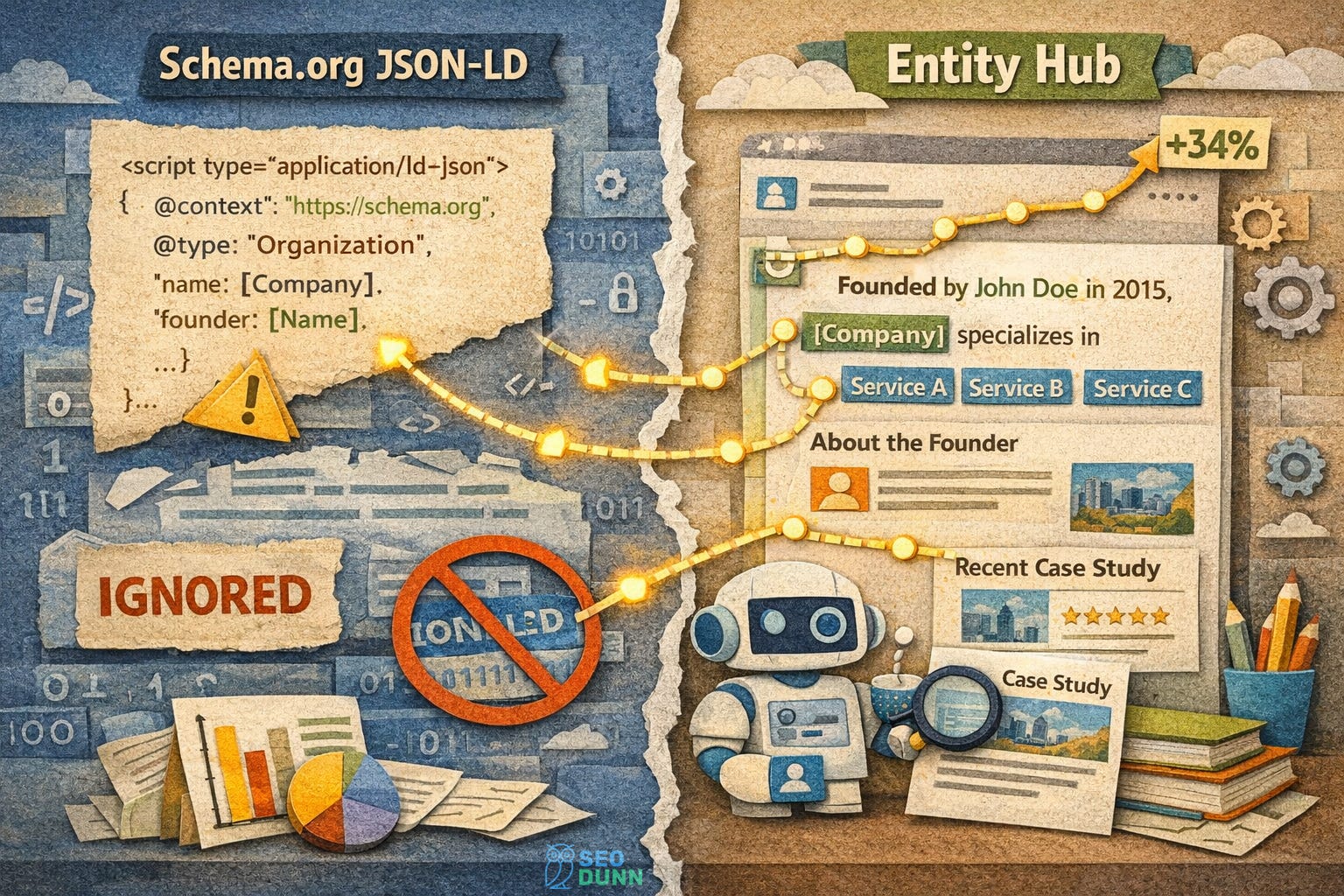
The WordLift team calls this concept an “AI memory layer,” and it aligns with something I’ve been saying for years: structure matters. But the kind of structure that matters has shifted. It’s no longer enough to structure your data for machines behind the scenes. You need to structure your content for AI systems that read the page itself.
This is a significant finding, and it’s one reason we implement and manage WordLift for clients who want to take their entity optimization seriously. Building proper entity hubs at scale is exactly the kind of thing that benefits from dedicated tooling.
The bottom line: implement your Schema.org markup (it still matters for traditional search and rich results), but don’t stop there. The real AI citation advantage comes from making your knowledge graph visible, connected, and navigable on the page itself.
Step 5: Build “Answer Blocks” Into Every Key Page
This is a proven technique.
An “answer block” is a concise, self-contained paragraph (40 to 60 words) placed directly after a question-formatted heading that provides a complete, factual answer. Think of it as writing the answer you’d want AI to quote.
Example:
H2: How Long Does SEO Take to Show Results?
Most businesses begin seeing measurable improvements in organic traffic within 4 to 6 months of implementing a comprehensive SEO strategy. However, competitive industries may require 8 to 12 months. The timeline depends on your site’s current authority, the competitiveness of your target keywords, and the quality of your existing content.
That’s 53 words. It’s specific. It’s factual. It’s citable. And it’s followed by 300 or more words of deeper explanation, client examples, and nuance that demonstrate your expertise.
The beauty of this approach is that it works for humans, too. Nobody is annoyed by getting a clear answer upfront. They’ll keep reading for the details because you’ve earned their trust.
Step 6: Enrich With Multimedia (Yes, This Matters for AI Too)
If you read my piece on how to add AI-generated multimedia to your content, you know I’m a big believer in enriching text with charts, infographics, and video. But here’s why it matters specifically for AI citation.
Multimedia signals depth. Pages with supporting charts, comparison tables, and embedded video are evaluated as more comprehensive. When AI systems are choosing between two pages that answer the same question, the one with richer content gets the nod.
A few quick wins:
Turn key statistics into simple charts (ChatGPT can generate these for you in seconds)
Create comparison tables for any content that involves evaluating options
Add a short video summary at the top of your most important pages (NotebookLM makes this remarkably easy)
Use infographic summaries for complex processes
This doesn’t need to take hours. Ten minutes with the right tools (I walk through exactly how in the article linked above) and your page goes from a wall of text to a multimedia resource that AI and humans both prefer.
Step 7: Refresh, Don’t Abandon
Here’s something the “start fresh” crowd won’t tell you: your existing content has value that new content doesn’t. It has age, backlinks, existing rankings, and (ideally) real traffic. Throwing that away is like demolishing a house because you want to update the kitchen.
Instead, reform it:
Update statistics and references to reflect current data
Add your answer blocks under restructured question-headings
Weave in recent client examples and personal expertise
Implement structured data markup and entity optimization
Add multimedia where it strengthens the content
AI freshness matters. Studies show that AI systems use recency as a “hard filter,” meaning outdated content is less likely to be retrieved at all. A page that was last updated in 2022 with statistics from 2020 is essentially invisible to AI citation systems, no matter how many backlinks it has.
Set a calendar reminder: review your top 20 pages every quarter. Update data, add new examples, refresh your answer blocks. This ongoing maintenance is what separates sites that get cited from sites that get ignored.
The Content AI Loves (And the Content It Ignores)
Let me give you a quick cheat sheet based on what I’ve seen working (and not working) across dozens of client sites.
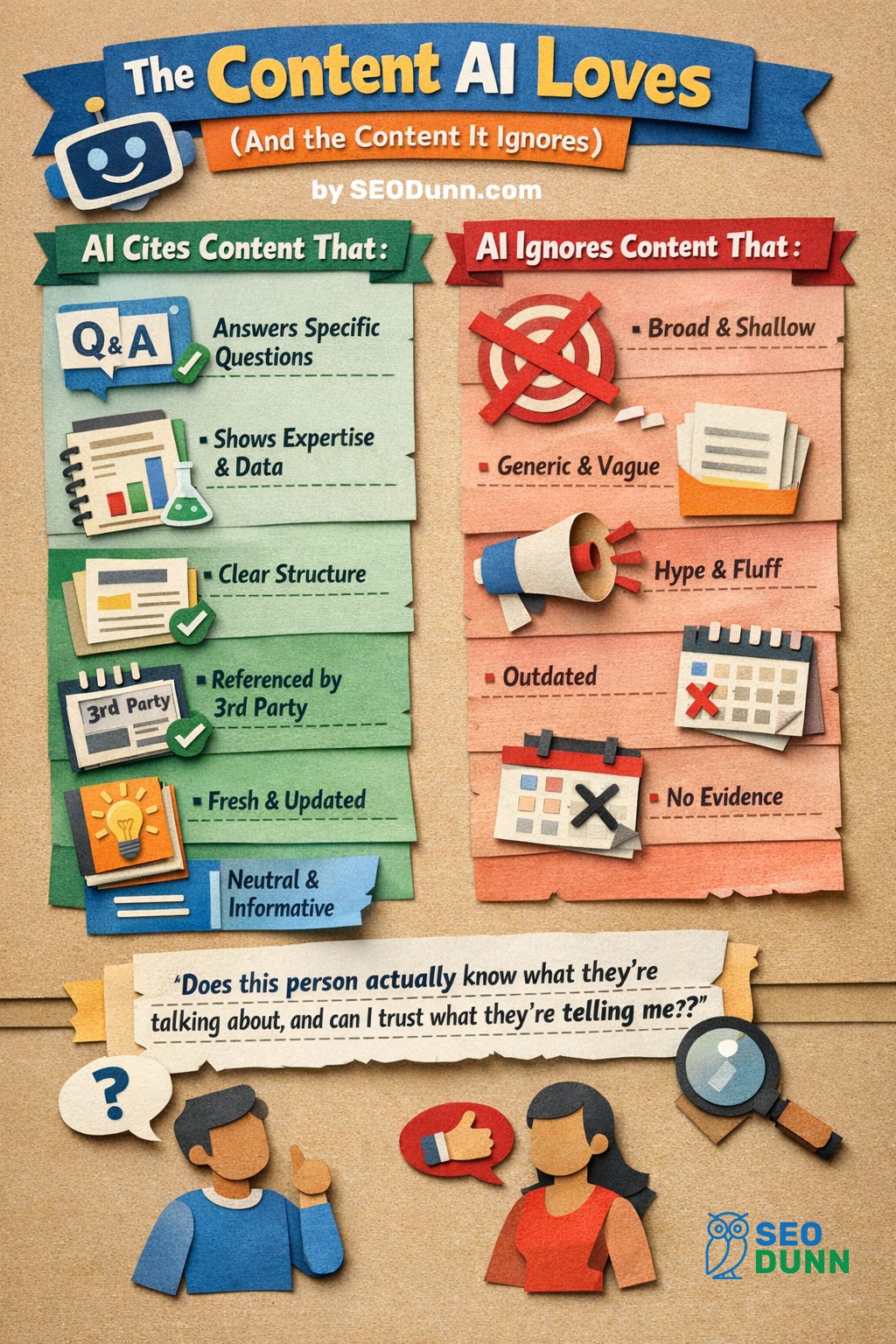
AI cites content that:
Answers specific questions directly and concisely
Demonstrates real expertise with concrete examples and data
Uses clear hierarchical structure (question-headings, answer blocks, supporting detail)
Gets referenced and validated by third-party sources
Stays current and freshly updated
Takes a neutral, informative tone (educational over promotional)
AI ignores content that:
Covers topics broadly without depth on any single question
Reads like it could have been written by anyone (or any AI)
Buries key information under marketing fluff
Hasn’t been updated in over a year
Is overly promotional or sales-focused
Lacks supporting evidence, data, or real-world examples
Notice a theme? AI is essentially asking the same question your best customers ask: “Does this person actually know what they’re talking about, and can I trust what they’re telling me?”
If you’ve read my piece on why Google has lost its way, you know I have concerns about where the search giant is headed. But here’s the irony: AI search systems, including Google’s own AI Overviews, are actually better at rewarding genuine expertise than the traditional algorithm ever was. Gaming the system with thin content and link schemes is getting harder, not easier. And that’s a good thing for businesses that do real work.
(Video note: NotebookLM let me down a bit with the following video… it is having problems with text overlap and contrast, but it’s still a bit better than nothing)
Your 30-Day Reform Plan
Don’t try to reform your entire site at once. That’s a recipe for burnout and half-finished work. Instead:
Week 1: Audit and Prioritize
Identify your top 10 pages by traffic and conversion value. Run each one through the three-question audit from Step 1. Rank them by how much reform they need.
Week 2: Restructure Your Top 3 Pages
Rewrite headings as questions. Add answer blocks. Weave in expertise and specific examples. Implement FAQ or Article schema. Contact me about Wordlift if you are interested in better AI results (ask about our special rates).
Week 3: Enrich and Update
Add multimedia to your reformed pages. Update any outdated statistics or references. Add recent client examples where relevant.
Week 4: Measure and Expand
Check your Google Search Console for any changes in impressions or click patterns. Use a tool like Semrush to monitor AI overview appearances. Pick your next three pages and repeat.
Then keep going. This isn’t a one-time project. It’s a new way of maintaining your content.
The Bottom Line
Your content isn’t broken. It was built for a world that’s shifting under our feet. The businesses that thrive in AI search won’t be the ones that produce the most content. They’ll be the ones that reform their existing content to be clear, authoritative, extractable, and unmistakably human.
AI has handed everyone the same superpower; when everyone’s super, no one is. But here’s the thing: reforming your content with genuine expertise, real examples, and clear structure isn’t something AI can do for you. That takes the one thing no algorithm can replicate: your actual knowledge and experience.
The question isn’t whether AI will cite your content. It’s whether your content is worth citing.
Let’s make sure the answer is yes.